
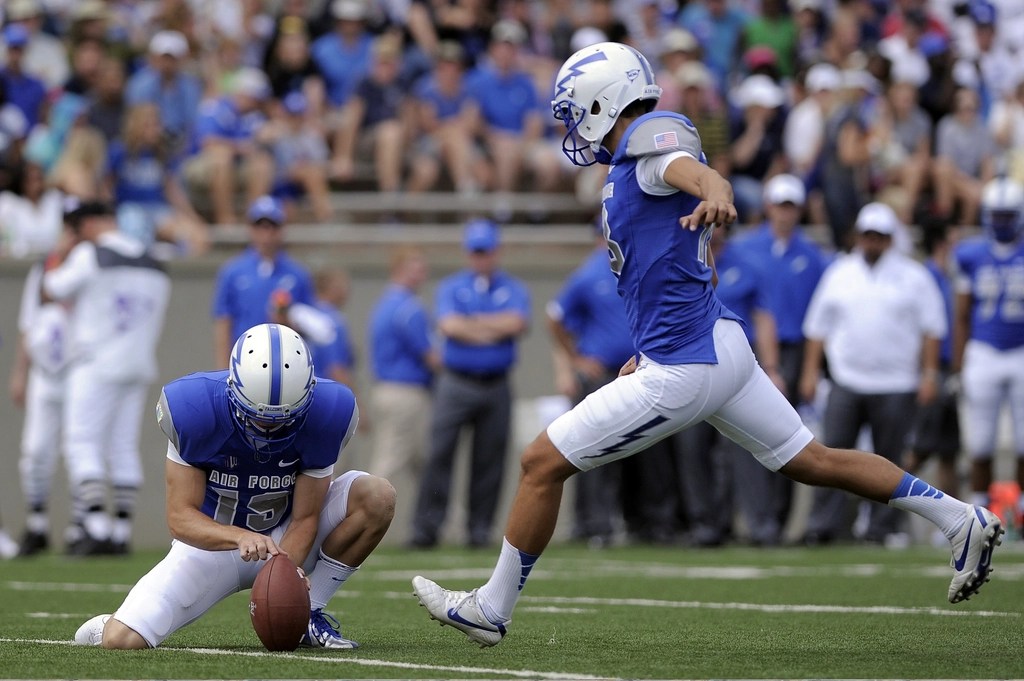
Not long ago, I covered the sidelines for a homecoming football game between my university and a highly ranked opponent. The season had been disappointing, and we were striving to get into playoff contention. An upset would build confidence for a strong end-of-season push. The opponent, on the other hand, was jockeying for playoff seeding, and it was a longshot my school would give them much trouble.
The game began furiously, and we were able to move the ball effectively down the field. The drive stalled deep in the opponent’s territory, and the special teams came out for a chip-shot field goal. Our place kicker was a reliable young man who practiced seriously and understood his importance to the team. He ducked his head, nodded for the snap, took careful aim…
And missed wide left.
This scene was repeated five times throughout the game. Extra points and field goals, sometimes from just outside the end zone, went sailing left or right, were blocked by the defense, or went low into the scrum of linemen. Players on our sideline grew disheartened. Fans groaned and started to catcall but then bit their lips. They didn’t want to belittle their own player, but it was frustrating to leave so many points on the field.
As the misses piled up, many started wondering: why send the kicker out? Obviously, it’s not his day. Shouldn’t we just go for two? As kick after kick started with a thud and ended with a sigh, it began to feel almost cruel. Why did the coach put the kicker in a situation where he repeatedly failed? Wasn’t it harmful, both to him and the team? Wouldn’t it be better to keep him on the sideline?
However, an interesting thing happened after each miss. The kicker was understandably disappointed, but instead of walking to the sideline with head hung, he trotted briskly back. His face was fixed in concentration as he mentally reviewed the play. His special teams crew patted him on the shoulder or behind, offering encouraging words before sitting on the bench and discussing. What happened? Was the snap too low? Did someone miss a block? The coach occasionally came over and gave the kicker a pat on the helmet, but mostly he let the players talk through things. When they decided what needed to be improved, they practiced kicking into the sideline net until feeling satisfied they had corrected the problem. Then they would huddle up, slap each other on the back, and get ready to try again.
Despite the kicking problems, the contest was very tight. The game went back and forth in the last quarter. The opponent manufactured a confident drive down the field, scoring a touchdown and leading by one with little time left. The ensuing kickoff was run back almost to midfield, putting our team in great position. A few well-placed throws and fortunate penalties brought the ball inside the five-yard line where the offense ran a few plays, intentionally bringing the clock to less than thirty seconds. Everyone tensed as the coach called timeout and huddled his players. The special teams unit once more ran onto the field. They were going for the winning field goal.
You could hear gasps throughout the stadium. We were so close! With only a few yards to go and having such a hard time with field goals the rest of the game, why not try for a touchdown? Why put the kicker through that? The home crowd clasped their hands as the kicking team got into their stances. They were nearly silent, while the opposing fans screamed raucously, trying to distract the errant place kicker. Almost too soon, it seemed, the snap was down, the kick was up. It fluttered in a weak rainbow over the lines, through the end zone…
And cleared the crossbar.
The stadium exploded. The home team leaped and yelled, swarming the kicker in hugs and blows on the helmet. He looked to the sky and hollered. The defense stood with hands on their hips, disbelieving. Our players made their way to the sidelines, still embracing the kicker. The game proceeded, time quickly ran out, and our team had achieved an unlikely upset. We ran to the locker room, the place kicker pumping his fist as the crowd launched cheer after cheer his way. He was the homecoming hero.
Earthly Benefits of Failure

Taking in this scene, I recognized a microcosm of life wrapped up into a two-hour sporting event, with both temporal and spiritual applications. From an earthly standpoint, failure is a common companion of our existence. We do poorly on the test, don’t get into the school we want, and take subpar jobs. We get into bad relationships, say stupid things, and get divorced. We make dumb decisions with our money, misuse our bodies, and waste our potential. We can be mean to others, selfish, and callous. All these things bring sadness and discontent.
It gets even more unfair when failure comes through no fault of our own. Others hurt us, or the elements combine against us to block our success. With so much negativity surrounding failure, how can it be turned to our good?
Evolutionary psychologist Nigel Barber describes several benefits of failure in a 2021 Psychology Today article. “People who fail repeatedly develop persistence in the face of difficulties…[and] are forced to adapt and change. Failure can spur creativity and innovation.” He cites historical examples of Thomas Edison, Theodore Roosevelt, and Harry Truman as individuals who endured severe personal failures that fueled future good decisions and success. Dr. Barber concludes, “Everyone can learn from failure, improving their resilience to the setbacks they will inevitably encounter in life.”
Spiritual Role of Failure
From a spiritual perspective, failure takes on even greater value. When we experience disappointment in any form, it is very easy to say: a loving God wouldn’t put me through this. The odds seem stacked against me. If I’m likely to fail, why even go on the field?
The place kicker can answer that question. If the coach had not given him the chance to keep trying, be supported by loving teammates, and make adjustments, he wouldn’t have experienced one of the most exciting moments of his life. The time he won the game. The time he got to be the hero.
Failure allows us to practice faith in ourselves, God, and His plan for us. The kicker showed faith in his coach to know best and took the opportunity to succeed, even when he had failed in the past. Conversely, the coach showed faith in his kicker to learn from mistakes and try again, even when the game was on the line. We know the importance of having faith in God, but we rarely remember that, in putting us in position to do His work, God shows faith in us. How empowering to know the great Creator trusts us to perform, even when He has ample evidence of our imperfection!
The best news is, despite our tendency to fall short, a win is already assured. In the Christian context, if we are on the home team, playing in the game, and trying our best, we will overcome sorrow and pain. The kicker’s process of reflect, counsel, practice, and resolve to do better is called “repentance.” “Thanks be to God, which giveth us the victory through our Lord Jesus Christ,” reads 1st Corinthians 15:57. Christ’s Atonement makes it possible to be changed and flourish despite past failures. Through it all, the Coach of Heaven and Earth is always there, patting our helmets, encouraging us to get back in the game.
Let us see our failures for what they are: a chance to learn and grow. An opportunity to develop resilience, creativity, and faith. God loves us, believes in us, and wants to help us reach greater heights. His desire is for us to have a happy homecoming. If we stay faithful, we will all have our moment under the stadium lights with glad teammates, adoring fans, and a well-pleased Coach.






 Medical Miracles
Leave a comment